Dan Aadland's building of his Spray 27 in Wood Epoxy
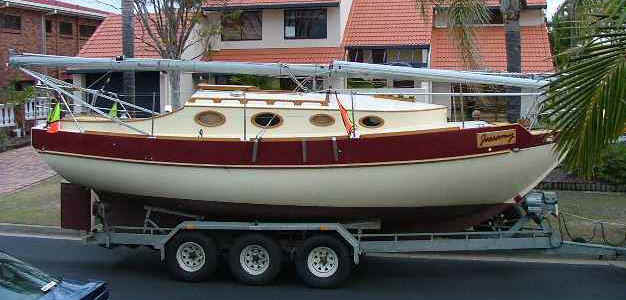
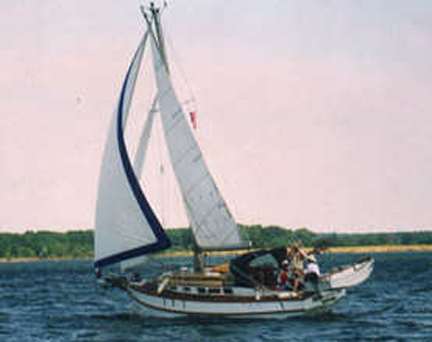
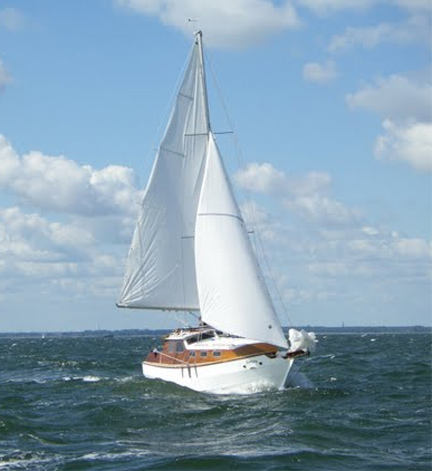
The lifelong desire to sail has prompted my present (major) project, a Spray
27 cutter designed by Bruce Roberts. This is the second smallest of his
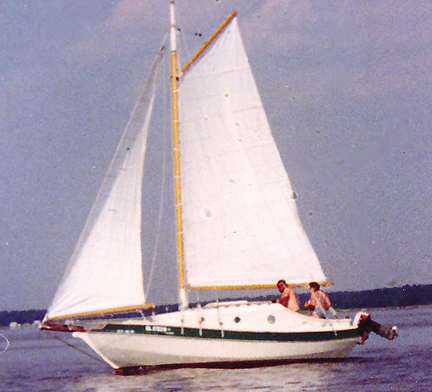
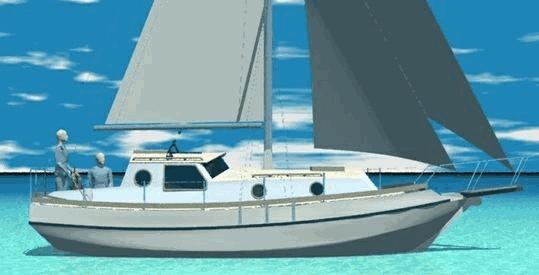
Spray series and the larger of the two trailerable ones. A multi-chine
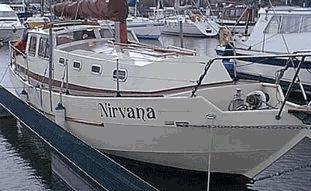
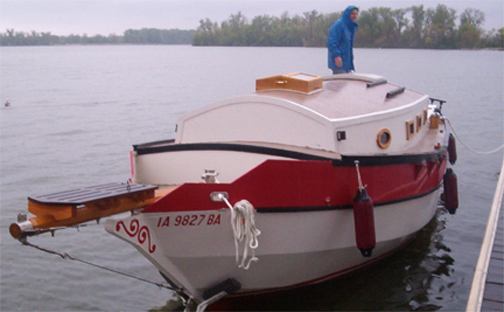
plywood design, the cutter can be built with either Marconi or gaff rigs and
in either pilot house or conventional sailboat configuration. Luckily,
decisions on those two matters need not be made until bulkheads are
installed, so I have a while yet to decide.
I made two modifications.
First, the Sprays have a
conventional transom which turns to vertical for the upper one foot. I kept
the taper of the transom all the way aft, which will increase cockpit (or
lazarette) space and overall length (to about 28'). The shape is more
pleasing to my eye. Secondly, I am building the hull with a modified
stitch-and-glue or, more accurately, epoxy chine method. I’ve built the hull
over the same temporary frames specified but eliminating the chine logs and
instead edge-gluing the plywood panels with filled epoxy.
The hull is roughed in and
when fibreglasses will be turned over with the temporary frames still
supporting it. At that point the fillets of filled epoxy will be installed
inside as the chines. This modification was done with the blessings of Mr.
Roberts himself, incidentally.
A Spring ‘99 Update: I
completed the planking, built up the keel with fir, and built a steel
ballast box to be later filled with lead and thickened resin. This
ballast box, still empty, was fitted into place and the wooden keel
laminated up around it. Then I removed it to be bolted in
position later with the hull upright.
I also located an
old-but-good Yanmar 8h.p. diesel, the old horizontal cylinder model, and
purchased it for later installation.
A stern view of the hull, now covered with 6 oz. fiberglass cloth set
in epoxy resin. (Much sanding and fairing remains before it will be
ready for paint.) To turn the hull we had, naturally, a party.
Two heavy Polly ropes were
run from the ends of the trusses on each side of our pole shed, under the
hull (but over the building form), then to cable-type “come-along's.”
To protect the hull we padded the area with tires and also put foam pipe
insulation over the ropes. Then we cranked on the come-alongs until
the hull lifted off the form. We lifted the hull until it went over gently
onto the ropes. Then everyone quickly skidded the building form
forward out of the way. Then we pushed the hull back onto the concrete
building platform and blocked it.
Final positioning of the hull
was easy, and with this nice old-fashioned straight keel design, the hull
ended up dead level with the waterline (as shown by the marks on the
temporary frames still inside).
Emily and I posed in front of
our sailboat to be, then she posed me by the stern. We’re tentatively
planing to name the boat Sjo Hest, “sea horse” in Norwegian, a marriage of
our Scandinavian heritage and our preoccupation with the world of horses.
Hopefully it will take us over the waters of Puget Sound and the Sea of
Cortez. Watch this space for more on the building of Dan Aadland's Spray 27 |

![s27-01[1].gif (17670 bytes)](../images/s27-01[1].gif)
![s27-02[1].gif (8044 bytes)](../images/s27-02[1].gif)
![s27-03[1].gif (8863 bytes)](../images/s27-03[1].gif)
![s27-07[1].jpg (13915 bytes)](../images/s27-07[1].jpg)
![s27-05[1].gif (8488 bytes)](../images/s27-05[1].gif)
![s27-06[1].gif (8926 bytes)](../images/s27-06[1].gif)
![s27-08[1].jpg (9077 bytes)](../images/s27-08[1].jpg)
![s27-10[1].jpg (22987 bytes)](../images/s27-10[1].jpg)
![s27-09[1].jpg (10867 bytes)](../images/s27-09[1].jpg)
![s27-11[1].jpg (9431 bytes)](../images/s27-11[1].jpg)
![s27-12[1].jpg (8703 bytes)](../images/s27-12[1].jpg)